

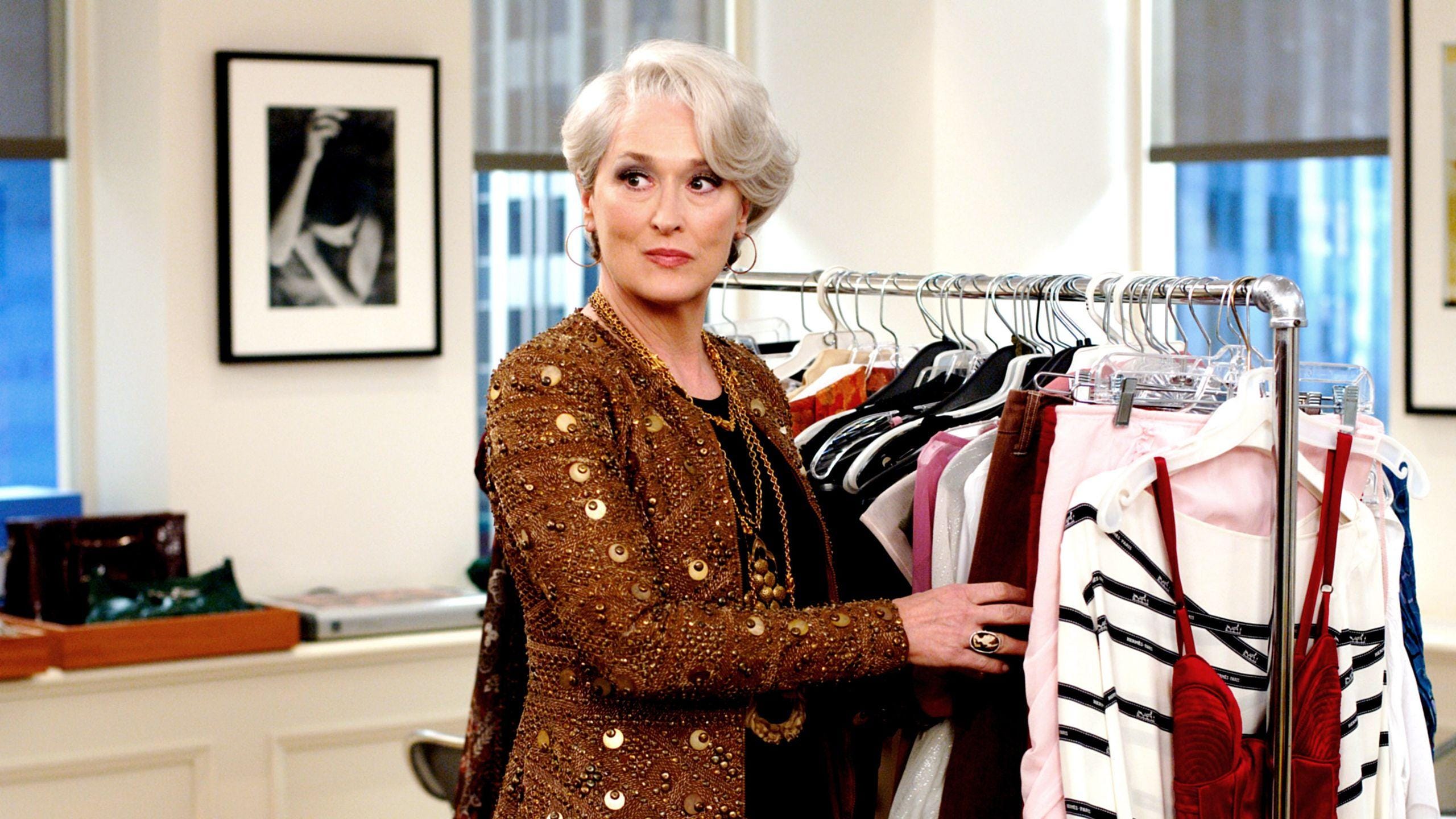
There are some cultural moments that don’t quite arrive as new experiences, even when they belong to the present. They come carrying memory, projection, and the weight of who we were when we first encountered them. You don’t just watch them—you measure them against earlier versions of yourself, against conversations that have lived on long after the credits rolled, against the mythology that builds when something becomes shorthand for a phase of life. For many of us—Millennial women specifically, who didn’t have too many role models of what it meant to be in a boardroom—The Devil Wears Prada offered a version of power we could study, even if we didn’t always agree with it. It shaped how we imagined ambition, how we understood work, and how we interpreted the subtle choreography of power long before we had the language for it. So when the sequel was announced, it didn’t feel unexpected; it felt like something that had been waiting in the wings, gathering anticipation without ever quite being questioned.
And, against my better judgement, I let myself be excited.
Alongside that anticipation sat something else, just as familiar—the understanding that sequels rarely hold the same weight as their originals. It’s a belief most of us absorbed early on, one that sits just beneath excitement, tempering it without fully diminishing it. Still, there are some stories we make exceptions for, not because we expect them to be better, but because we want them to return to us intact. We want them to hold the same shape they did when we first encountered them, even if we no longer do.
This morning, while trying to articulate what that return felt like, I told a friend that watching it was like someone had taken my favourite sweater and intentionally shrunk it because crop tops are in.
Not ruined, not unrecognisable, but altered in a way that feels deliberate and slightly disorienting.
I was 16 when the first film came out, at an age where ambition still feels directional and untested, where the future exists as something you can outline with surprising clarity. Journalism—specifically features writing—sat at the centre of how I imagined my life unfolding. It wasn’t just a career option; it felt like a natural extension of who I was becoming. Andy Sachs made immediate sense to me, not because she was extraordinary, but because she was trying in a way that felt deeply familiar. Her commitment to her work, her eagerness to prove herself, and that constant negotiation between who she was and who she needed to become—it all mirrored something I recognised in myself. More than anything, it was the way she responded to feedback—the willingness to absorb it, adjust, and keep going—that stayed with me.
That version of the future didn’t remain entirely imagined. A few years later, in 2009, I interned at the features desk of a newspaper in Bangalore, stepping into a version of the world I had once only observed from a distance. I was guided through the first few days by an editor and colleagues who knew what they were doing, and once I found my footing, the bylines followed. It wasn’t dramatic, it wasn’t punishing—it was structured, and it worked.
Much later, when I began having interns and reportees of my own, I returned to that version of myself more often than I expected—and, in some ways, to Andy as well. Not because either of us had it all figured out, but because we were willing to be shaped. I took feedback seriously. I wanted to get better. At the time, it felt like instinct; in hindsight, it was probably the most valuable thing I brought into those early roles.
That early stage wasn’t always as composed as memory makes it seem. My friends and I, as interns and in our first jobs, clashed more than we’d like to admit—with colleagues, with bosses—because we were unrestrained and raw. There was energy, but not always direction. Sometimes we were like bumbling puppies—eager to please, but also snapping at everyone’s heels, not yet sure how to channel that urgency into something constructive.
Watching the sequel, I couldn’t help but notice how different that energy now looks on screen. When I saw Andy’s dynamic with her own assistant, it felt recognisable, but not in the way I expected. The Millennial interns of the past are now managers, and the response has shifted—from being sharpened by expectation to offering reassurance, validation, a kind of constant cushioning. Perhaps because we didn’t receive it, we’re more inclined to give it. But in doing so, something changes. The dynamic no longer carries the same tension as Andy and Miranda’s did. It’s softer, more accommodating, but also less charged—less formative in the way that friction once was.
Miranda existed in an entirely different register. She was fascinating and intimidating in equal measure, not because she was loud or overtly cruel, but because of how exact she was. The economy of her words, the way a single glance could recalibrate a room, the expectation that competence was only the baseline—this was a form of authority many of us would later encounter in internships and first jobs. Whether we realised it at the time or not, that dynamic shaped us. It sharpened our instincts, complicated our relationship with power, and influenced how we learned to navigate professional spaces.
I’m 36 now, which means I’ve lived enough life to no longer approach that world as an observer. I’ve been inside those rooms. I’ve worked under people who carried echoes of Miranda’s presence, and I’ve also held roles where I’ve had to reckon with what authority looks like when it’s mine to wield. Time adds texture to things that once felt absolute, and I went into the sequel carrying that texture with me. I wasn’t looking for a replica of the original; I was looking for something that met me where I am now while still retaining the edge that made it unforgettable.
I waited with bated breath—Coke Zero and a tub of cheese and caramel popcorn in hand—for that familiar tightening in the chest when Miranda delivers a line so precise it feels surgical, for that recognition of power dynamics that are as compelling as they are uncomfortable.
But that moment never arrived. I had waited for the impact of her cutting remarks, and instead I watched them land without consequence, their sharpness blunted before they even reached the surface. Every character felt as though they had been placed on a chessboard—positioned with intent, but drained of force. Only instead of moving like players who understood the stakes, they moved like pawns of time: careful, contained, almost apologetic in their progression. In the original, each step felt deliberate and dangerous, every interaction carried the possibility of gain or loss. Here, the movements feel smaller, safer, as though the game itself has been rewritten to ensure no one truly loses. What once felt like power now reads as restraint, and not the kind that signals control, but the kind that suggests hesitation—rendered with a kind of polished indifference that keeps everything in place and nothing at risk.
And this is where I slip, almost unwillingly, into questioning territory. Because the muted quality of it all doesn’t feel accidental—it feels calibrated. So I have to ask: why does it feel this way? What, exactly, has shifted so fundamentally that a character once defined by her precision now feels so carefully restrained?
Part of the answer, I suspect, lies in the way authority itself has been reconfigured over the years. We no longer hold it on the same pedestal, no longer accept it as something that exists above interrogation or beyond accountability. Workplaces have flattened, at least in theory, and with that flattening has come a redistribution of power—more voices, more visibility, more scrutiny.
Entire generations have entered the workforce with a different vocabulary around boundaries, respect, and what constitutes acceptable behaviour, and that has inevitably reshaped how leadership is performed and received. The kind of unquestioned dominance Miranda once embodied doesn’t sit as easily in this landscape, and perhaps it shouldn’t.
But even as I recognise that, I can’t ignore the other reaction that sits alongside it, sharper and far less diplomatic. Because what replaces that dominance here doesn’t feel like evolution—it feels like dilution. It feels like something has been edited down to ensure it offends no one, unsettles no one, demands nothing from the audience except passive agreement. And that’s where the frustration creeps in, because the original never asked for comfort. It asked you to sit in the discomfort of ambition, to confront the cost of proximity to power, and to reckon with the ways in which admiration and fear can coexist.
So yes, I understand why the edges have been softened. I understand the cultural context that makes a character like Miranda more difficult to render in her original form. I even agree, on principle, with the shift toward more accountable, self-aware leadership. But understanding it doesn’t make it any more satisfying to watch. Because somewhere in that transition, something essential has been lost—not cruelty, not even severity, but the clarity of force.
And I want to say it plainly, without qualifying it into something more palatable:
Where are the fangs?
Not for the sake of nostalgia, and not because the past was better, but because the absence of them leaves behind a version of the story that feels strangely weightless. The stakes blur. The tension dissolves. And what remains is a world that looks familiar on the surface but no longer carries the same charge underneath. The fashion delivers, as expected—but everything else lands with a kind of polished indifference. Almost… meh.
There’s also a more personal layer to this, one that has less to do with the film and more to do with the distance between who we were and who we are now. There is a particular kind of dissonance in returning to something that once felt definitive, only to realise that it no longer lands with the same intensity. Not because it has lost all value, but because we have changed in ways that make us less susceptible to its original pull.
Perhaps the sequel didn’t fail to meet me; perhaps it met a version of me that no longer exists. Or perhaps it did change, and I needed it not to. Either way, what many I was waiting for wasn’t simply a continuation of a story, but a reactivation of a feeling—the electric mix of intimidation, aspiration, and unease that made the original so memorable.
Instead, what we’re left with is something that feels more aligned with the present moment—self-aware, measured, careful in its portrayal of power and ambition. These are not inherently negative qualities, and in many ways they reflect necessary cultural shifts. But they don’t quite translate into the kind of tension that lingers. And so the metaphor of the sweater holds, not because the sequel is without merit, but because it no longer fits in the way we remember. Somewhere along the way, both the garment and the body changed shape, and what remains is the subtle but undeniable mismatch between the two.
I don’t regret watching it, and I don’t think I ever could. But what once felt like something to study now feels like something to move past—like a dress that looks great on the rack, but one you have no hesitation putting back once you take a closer look.
this is the sharpest and most articulate encapsulation of a feeling or rather the lack of! so well written!!